
BOOK REVIEWS
The Queen’s Atlas: Saxton’s Elizabethan Masterpiece, by David Fletcher, Bodleian Library, 9781851246205, £35.
Review by Richard Knowles
In our current times we tend to take atlases and road maps very much as a matter of course, particularly in the time of satellite navigation systems which so effectively guide us around the country. But things were very different in the Elizabethan period, with mainly local estate maps and no reasonably accurate overview of the geography of the realm.
This rather splendid new volume explores the background of Christopher Saxton, his career as a surveyor and the creation of his “Atlas of England and Wales”, published in 1579. It explains in detail the background to the work and the way it had royal patronage from Elizabeth I but also private financial support from William Cecil and Thomas Seckford. The volume covers surveying techniques and includes a full-colour reproduction of the atlas, albeit on a smaller scale than the original.
Fascinating as the volume is, the subject matter has a far greater local interest for members of the Wakefield Historical Society than might at first be thought. Christopher Saxton was born in the 1540s at Sowood, situated between Horbury and Ossett, and later moved to Dunningley near West Ardsley; this tiny hamlet was featured on his map and subsequently on later impressions. But there is a further local connection in that in 1979 our past president, Heather Lawrence working with Ifor Evans, published with Wakefield Historical Publications, “Christopher Saxton, Elizabethan Mapmaker”. This latter work is fully referenced in the volume here reviewed, and the two volumes rather tend to complement each other. The new volume focuses on the background and Atlas, whilst the earlier volume, although covering the Atlas, features much detail of Saxton’s later surveying work that he was commissioned to undertake, fully holding its own in academic terms, possibly indicating how progressive our society was back in 1979.
So, this new edition is a book worth adding to any historian’s bookshelf, not only providing an attractive reproduction of Saxton’s masterpiece, his Atlas, but also a background to the emerging cartographic needs of Elizabethan England.
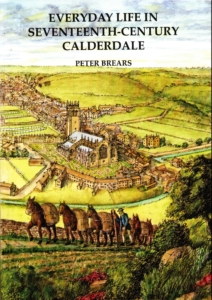 Everyday Life in Seventeenth Century Calderdale, by Peter Brears,
Hebden Bridge Local History Society, ISBN 978106856104, £20.
Review by Richard Knowles FSA
Peter Brears’ scholarly work, “Everyday Life in Seventeenth Century Calderdale,” provides an in-depth examination of the lives of individuals residing in Calderdale during the late 1600s, utilising probate records from the Halifax parish as primary source material. The book meticulously reconstructs the daily existence of historical inhabitants and their environment through a combination of academic text and authentic illustrations.
Peter requires no introduction to this Society. He is a long standing friend, having been a Council member back in the 1970s. He is a food historian of high repute and was declared by no less than Country Life magazine A National Treasure and so he is. Amongst all of this Peter has had a distinguished career in the museum world and relates the peaks and troughs of this occupation in his memorable volume, Carry on Curating. With our Society he recently published the remarkable volume, The Buildings of Tudor and Stuart Wakefield.
However here we consider his latest publication, this time with the Hebden Bridge Local History Society. The Calderdale area has risen to fame through the recent series of television programmes that feature the drama of the surrounding countryside and its characters. Its fame should however delve back much further, and Peter admirably achieves this in the volume featured here. He takes the probate records from 1688 to 1700, of the parish of Halifax, so fortuitously transcribed by the late Alan Petford and two groups established to carry the work on. Peter manages to bring these records to life, re-populating the Calderdale landscape with the people, their trades and their possessions, His scholarly text explores the lives of the inhabitants of this sometimes rugged landscape and tells how they earned a living, indeed how they lived their lives and how they fitted out their homes and workplaces.
But this volume is more than just a re-telling of the past, it is enriched and brought to life by Peter’s inimitable drawings, reproduced in colour which show us in admirable and authentic detail, the artefacts they used, the layout and look of their homes and indeed how the furniture was arranged. It shows the very people of Calderdale at their everyday labours, industrious to further their place in the community. If not quite a time machine, nevertheless this volume takes us back to a different age, whilst remaining within a familiar landscape and populated by people with similar aspirations as we have today.
The Hebden Bridge Local History Society and all of those others involved, are to be congratulated not only on publishing this volume but in their endeavours in making the original manuscript material available and to Peter for making the folk of seventeenth century Calderdale live and breathe again.
Going Underground, Wakefield, by Paul L. Dawson, 9781389118973, Amberley Publishing, £15.99
Review by Richard Knowles
This is one of a series of books published by Amberley under the overall title “Going Underground”. The aim of the series is to explore beneath the surface of the town or city of the title, interpreted in broad terms. These explorations may include literally, cellars, disused railway tunnels, burial grounds as well as industries such as, here coal mining. It also encourages seeking out, “digging up”, more unusual aspects of an area that are to some extent hidden.
Paul Dawson would seem to achieve these aims admirably. He is of course a member of our Society and has had published a number of volumes on the city, as well as being an authority on the Napoleonic armies. In the context of our Society, it is rewarding to see him acknowledging our distinguished former members John Goodchild and Kate Taylor.
Here, in this, his latest volume he explores actual subterranean features of our city, including, coal mining and the many cellars which are a legacy of the city’s trading past. He is on familiar territory when he explores the catacombs beneath the Westgate Unitarian chapel, which are indeed a fascinating feature, being unique in the north of England, with many distinguished characters from Wakefield’s past being interred there. As the author goes on to explain, Wakefield also has other crypts, for instance the Chapel on the Bridge and a more recent one beneath the Cathedral.
However, to purely regard this volume as one of only physical “underground” features would be to do it an injustice. This slim volume, of a no doubt proscribed length of 92 pages, manages to explore a variety of some of the little known aspects of our history. These include “underground” political movements and topics such as education and more recent, often forgotten history, whilst following the brief and retaining that subterranean flavour throughout. This is, at least for the reviewer, the most welcome aspect of the book, together with a collection of interesting and in some cases “fresh” photographic images. These make up around half of the book and are in the main well printed. Also, of particular interest and poignancy are the various contemporary memoirs of wartime Wakefield, including those of the authors own family and most memorably his grandmother. All of these aspects make this a worthy addition to writings on Wakefield and avoids the repetition and nostalgic aspect of the plethora of mainly photographic books on local history that we tend to see more recently produced.
Whilst fully realising that the series is aimed at the popular market, this volume is so packed with facts that it would have been useful to have a few footnote references and perhaps a rather more extensive bibliography. But this is a mere quibble of a limitation no doubt imposed by the publisher, the book fulfils its aim and its brief admirably and is worth its space on your bookshelf.
The Ricardian Century, A History of the Richard III Society, by John Saunders, 9781068651328, The Richard III Society. No price
Review by Richard Knowles.
There is some synchronicity with this volume in that our own Wakefield Historical Society was founded in the same year as the Richard III Society, each celebrating their 100th anniversary in 2024. As the author states, that highly significant year of 1924 marked two General Elections in the UK and a Presidential election in the USA, as well as the foundation of the two societies. Indeed, a momentous year.
The Richard III Society is something of a curious thing, a Society dedicated to a single person and that being an English King now dead for over 500 years and 439 when the Society was formed. However, the Society, from modest beginnings, having started life as The Fellowship of the White Boar and unlike our own Society, formed in a very unstructured way with no Minutes or other details However despite this it has managed to prosper not only in the UK but worldwide having grown to a truly substantial membership. This is no doubt in part due to the energy of its members and their organising ability, but also the fact that the Society has managed to extend its range and expertise to an academic study of the larger fifteenth century. It is this latter point that is the Society’s greatest achievement.
As anyone studying a Society history over an extended period of time discovers, the society is divided into phases of time, rather in a geological fashion. The author of the book reviewed realises this, and his chapters divide the account of the Society into a sequence of “years”, for instance “The Bacon Years”, “The Potter Years” etc. This seems an admirable way of tackling such a subject matter making it easier to follow and more accessible for the general reader. The author faithfully records the ups-and-downs of the Society and its interests and activities over the years. Understandably any account of the Richard III Society includes a mass of names of those who have contributed to its growth and expansion and no doubt part of the fun of this book, for those involved, is seeking these names out.
Any history of a single Society is perhaps an exercise in navel gazing and this volume does understandably not escape this challenge, but along the way it includes many interesting facets of the Society’s activities and thereby illuminates way-markers along the way.
One may rather wonder if it gives full credit to some of the regional groups that were so active over the years, but then nearly half of the book provides appendices covering such details as its Officers, the many AGM details, Awards, Royal patronage and publications etc. Inevitably in a complex account of this nature, with all of its names and detail, it has to be accepted a few minor errors creep in.
Perhaps not a book for the general reader, but if you are interested in Richard III, the broader fifteenth century and certainly if you have been involved with the Society, you are sure to find things of interest within its pages.
“Mills Transformed – Stories of Mill Regeneration” by Neil Horsley (John Hudson Publishing)
ISBN 978-1-7385400-0-6 hard cover £25
ISBN 978-1-7385400-1-3 PDF ebook £19.99
In the last 10 years Wakefield has seen the transformation of the mills at the Waterfront as Tileyard North has repurposed the mill buildings. Textile mills were part of the industrial landscape in our region but now, sadly, hundreds of textile mills now sit derelict and forgotten.
Neil Horsley describes the repurposing of over 30 derelict textile mills including Tileyard North for a variety of new uses. Well illustrated with the author’s photographs, the book celebrates our mills heritage and champions the reuse of mills. The author, drawing on his professional experience in town planning and urban regeneration, demonstrates what makes a successful renovation scheme and provides a series of recommendations for other developments.
‘Celebrating Wakefield’ Paul L Dawson (Amberley Books, RRP £15.99) ISBN 9781398113497
Review by Phil Judkins
A useful test of whether a historical book has real value is to assess whether it has changed your mind on the period, place of events it describes, and how many new areas for research it opens in your mind. This book has certainly given this reviewer a new perspective on significant periods and personalities in the history of Wakefield, and presented a multiplicity of little-known or unknown people and places which he would like to research or see researched, such as the Boshazadin family, the city’s first Indian immigrants in the 1850s; American funding father Richard Henry Lee, educated at Wakefield’s Grammar School; Wakefield-born first female Pulitzer Prizewinner Ann O’Hare McCormick; Abimelech Hainsworth’s, the Pudsey firm whose cloth covers the House of Lords Woolsack, founded by a former partner of the father of Wakefield artist Louisa Fennell; or ‘merchant prince’ Thomas Charnock, one of two men known to have owned a slave actually in Wakefield itself, he being 16 year old Richard Brown, baptised in 1763. Excellent accounts are given of Wakefield’s ‘Communist preacher’ the Reverend John Goodwyn Barmby, abolitionist and campaigner for universal suffrage, and the little-known ‘Votes for Women’ campaigner Florence Beaumont among many others, with songbird Jayne McDonald bringing us right to the present day.
Two suggestions can be made. First, Amberley need closer proof-reading – on p.73, bells ‘peal’, not ‘peel’; p.80, ‘steam powder’ is surely ‘steam power’, and elsewhere ‘Frist’ for ‘First’, ‘aide’ for ‘aid’, and so on; and photography of houses in St John’s Square (p.33) is best attempted in winter unless the aim is to show mature green trees! More importantly, given that Square is described as ‘the peak in Wakefield’s material prosperity’, there is scope for an interesting book bringing together the many stories of all those who have lived in that Square. Likewise, this book firmly establishes the importance of Unitarians in the history of Wakefield, and this should set the ground for a second book to illustrate the importance of Wakefield’s rival Anglican community, and the long-running friction between them and the Unitarians who worshipped with their communist preacher Barmby at the Westgate Chapel – a friction which descended into decidedly irreligious ‘dirty tricks’ such as the failed attempt to eject the Gissing family from house and home. This reviewer looks forward to seeing Paul’s capable pen tell the full stories!
This book is an outstanding and thought-provoking work, packed with Paul’s detailed research, illuminated with his insights and explanations, and including new areas of knowledge not previously described by Wakefield’s historians. Very much a ‘must-have’ for the bookshelves of those interested in the history of this city, the (dark) story of how it made its some of its money, and some of its prominent citizens.
Five stars – a thoroughly recommended and engrossing purchase.
FIGHTING NAPOLEON AT HOME: The real story of a nation at war with itself. Paul L Dawson, Frontline Books 2023. ISBN 978-1-39909-635-5 RRP £25.00.
“It was the best of times, it was the worst of times, it was the age of wisdom, it was the age of foolishness”. Many of use remember the opening lines of Charles Dickens’ “Tale of Two Cities” as a set text for GCE (as it then was) English Literature, without also remembering that this purple prose opening paragraph concluded “In short, the period was so far like the present period that some of its noisiest authorities insisted on its being received, for good or for evil, in the superlative degree of comparison only.”
So it is with the period of history Paul Dawson has set himself to describe and analyse, the French Revolution and the Napoleonic Wars. Read his book – as I urge you to – and, as you read, you will increasingly wonder whether you are reading about today in his descriptions of increasing polarity of views with less and less middle ground, increasing mob intolerance of liberal opinion, dissenting religious opinion, and ethnic minorities, and in the development of nationalist and loyalist views which would even recently have been thought extreme.
There were, as Paul describes, many more anchors in place, legal and economic, to which those who wished might tie extreme beliefs – a tiny minority of wealthy people with the vote; the vast mass of the poor increasingly crammed into the growing insanitary slums of the new, industrial cities, unrepresented in Parliament; many of the class of the merchants who provided work disenfranchised by their religion, for there was a single state religion, jealous of its privileges; and horrors such as slavery still entirely legal.
With the use of many referenced archives (including that of John Goodchild) Paul traces both the threads of revolution through West Yorkshire and the nation – a separate book covers events in Ireland – and the rise of military repression, in the form of locally-raised militia, with their violent civilian supporters in urban mobs fomenting anti-liberal riot. He deftly sets in context the local schism between the branches of the Westgate Milnes family, the billionaires of Wakefield and the grand houses of London’s Piccadilly of thosetimes, and provides us with insights into the riots in Sheffield, Leeds and in communities further afield.
The desperate starving position of the urban poor, their increasingly politicised reaction, and the violence of repression exemplified by the Sheffield Norfolk Street militia charge, killing two and injuring 50, are well described, as are the ‘Gagging Acts’ and the webs of spies and agents created by both loyalists and revolutionaries, with postmasters and landlords threatened with their livelihoods to inform. The Militia volunteers themselves began to mutiny and disobey orders to repress their workmates, friends and relatives. Increasing spies, and food barges began to be seized. Among the wealthy, the feeling became patent that the poor had no right to protest; as Paul observes, it is not hard to find echoes of this view today.
The narrative is built convincingly to its inevitable conclusion with the Despard trial and the execution and, horrifically, the perfectly legal but horrendously botched post-hanging beheading of Despard himself.
5 Stars – a very well-researched account of a previously almost-unknown aspect of history of both national and local interest. Thoroughly recommended.
Review by Phil Judkins
‘Wakefield: A Potted History’ by Paul L Dawson (Amberley Publishing, (£15.99) ISBN 9781398107489
This book fills a long-empty hole in the histories of Wakefield, for an up-to-date, accessible, and easy-to-read history for the time- pressed general reader who wishes to become acquainted with the main features of the history of this city without being overloaded by irrelevant facts – and I am delighted to say, fills that gap very well indeed. The book is well-illustrated with appropriate and properly-credited images, enhancing the reader’s understanding of significant places and people without going into unnecessary verbiage. A copy of this book should be in the hands of every visitor to the city (and given by Wakefield Council to every consultant paid to advise on aspects of Wakefield’s heritage, which would spare your reviewer and our WHS President listening to one consultant explaining that he had never been to Wakefield and knew nothing about its layout).
Paul’s book walks the reader through Wakefield’s history chronologically, taking care to explain what we know as fact and what we must infer from archaeology, including the latest excavations, from surviving earthworks and buildings, and from incomplete archival material. It is pleasing to record that he has set in context his own work on the unpleasant but important topic of slave-derived wealth, and that he has included and described those significant buildings such as Westgate’s Golden Cock and Corn Exchange, now no longer with us thanks to the 1960s mania for demolishing every aspect of our medieval, Georgian and Victorian history the planners and their wrecking balls could access. Paul’s themes – housing, religion, commerce, education, transport and health – are well explained and point the way to further insights without dwelling on unnecessary detail, and dates are used to illuminate rather than bewilder the reader.
There are, of course, quibbles which can be made (it would indeed be a truly remarkable book if there were not) – for example, Amberley seems to have a love of tinting every image in an odd shade of sepia, where the original back and white would bring out more detail. Paul’s excavations in his own garden on South Parade were fortunate indeed in producing, from a single trench and surface finds, a complete sequence of pottery from Saxon times to the present day (your reviewer’s work on major excavations in 1960s Doncaster barely achieved this), and, as Paul rightly notes, topsoil can be brought in from elsewhere to city centre gardens, as indeed it still is today. These are, however, matters of detail when set against the value of the complete work.
Five stars: a valuable and important book, a most helpful introduction to the history and heritage of our city which is of both immediate and lasting value, and which is an essential addition to the bookshelf of everyone interested in Wakefield, thoroughly recommended for purchase.
Review by Phil Judkins
‘Clara Clarkson’s Merrie Wakefield’ (based on the Diaries of Clara Clarkson (1811-89) of Alverthorpe Hall, Wakefield) by Ann K. Jacques (Dream Time Creative, £45.00, paperback), 9781739926908
It is always good to welcome a fresh book on the social history of Wakefield and its district, even if part of this particular book is something of an old friend. The volume is actually in two near equal parts. The first is a facsimile reprint of the 1971 edition of Clara Clarkson’s diary or ‘journal’ as she termed it. It was first published by the late lamented West Riding Printing Company, whose occupation of their fine premises in George Street, Wakefield some may remember. It will be recalled that they were also responsible for publishing and printing, our founding President J.W. Walker’s classic, Wakefield, Its History and Its People, the first edition in 1934, and the second edition in 1939.
The author/editor, of the 1971 book was Ann Jacques who lived in New Zealand and was the great-great niece of Clara Clarkson. Of this 1971 edition only 500 were printed and these nicely produced hardback volumes are now somewhat elusive on the second-hand book market, so it is useful to have this new edition available. Working from New Zealand we can perhaps excuse the occasional historical lapses that one can find in the introductory linking notes, for instance on p. 1 Wakefield’s Parish church did not have Cathedral status until 1888, the year outside the time period that these surviving journals encompass, similarly on p. 7, we now know that Sandal Castle does not have Roman origins. However, if one reads these linking sections with an awareness, it in no way detracts from the fascinating ‘journal’ entries that throw much light on life and mores of town life in Wakefield. Clara wrote the ‘journals’ from the age of 15 and of the 40 leather bound volumes only 4 survived the ravages of time and family, these covering the years 1831 to February 1834, picking up again in May 1837 to May 1838, the final ‘journal’ is of 1875-6.
The Clarkson family obviously had a knack for memorialising as Clara’s relative Henry Clarkson was to publish in 1887 Memories of Merry Wakefield, an Octogenarians Recollections, which makes a useful reading companion to this volume. Interestingly in 1875 Henry was encouraging Clara to invest in railway shares, but she was having none of it, p.143.
The reissue of these ‘journals’ very much catches the zeitgeist of the moment but based on the surviving information and whilst they were written in a form of code, Clara is no revelatory Anne Lister and further speculation upon her personal life, without corroborative evidence, would be unhelpful to any future historian. Her ‘journals’ tell of her life in the town attending chapel, meeting her friends and neighbours and relating her own and other people’s health. However, they also cover the controversial politics of the day, her travels and provide an insight into the people that she met, these factors lift these records above the purely parochial.
Just how ‘merrie’ Wakefield was at this period remains an open question with riots, outbreaks of cholera and typhus and Clara’s own health issues, ranging from “I felt quite ill in the morning and spat a great deal of blood as soon as I awoke”, January 18th 1834 – to – “My health has been bad and I know I have a fatal disease…” December 31st 1876. Despite all of this, or perhaps because of it, she was to live a good few more years, only dying in 1889.
The second part of this volume, A Companion to “Merrie Wakefield” by Ann K. Jacques is impressive research by Helga Fox, containing 23 pages of genealogical tables, a history of Alverthorpe Hall (where Clara was born) together with a page-by-page series of notes introducing us to the people and some of the events covered in the surviving ‘journals’. These add real interest to the reading of the original volume and rattle the bare bones of Clara’s circle of acquaintances. Wakefield, if not perhaps truly ‘merrie’ at least appears to have been sociable! The volume is completed by colour images relating to associated projects.
This brings me to the physical aspects of the volume. Whilst I certainly fully appreciate the economic challenges posed by publishing and bookselling, particularly of small print runs, which I assume this is, the price of £45 for a paperback volume feels somewhat high, even by academic publishing standards and will inevitably restrict access to the book, which is indeed a pity. In addition, whilst the facsimile reprint is well done and is easy on the eye, the second portion of the book is set in a very small typeface, which, whilst perhaps understandable based on production constraints, is not such easy reading.
Notwithstanding the caveat of price, for anyone interested in the inhabitants of mid nineteenth century Wakefield this is a volume worth reading and having on one’s local history bookshelf.
Review by Richard Knowles FSA
THE BATTLE AGAINST SLAVERY by Paul L Dawson (Frontline Books, £25.00 hardback, Kindle £9.99) ISBN 9781399018487
Many books claim that ‘history will now have to be rewritten’ as a result of their publication, and the claim is only very rarely true; I am pleased to say that this, Pauls 30th book, is one of the exceptional cases. Knowing that a work proving that many of Wakefield’s notable historical figures derived their wealth, directly or indirectly, from slavery is not likely to be easy reading for many today, Paul has taken care to marshal a formidable array of facts, many from the UCL database, many from his own researches into Unitarian families, into a comprehensive proof of the interrelationship of many locally and regionally prominent families with the slave trade, slave ownership, and slavery-derived profits. Doubtless also Paul bore in mind that such a weight of facts was essential since his acknowledged mentor, John Goodchild, could never have penned this book, as John was opposed to its central contention. Paul’s conclusions show that his work is no mere polemic; as he rightly reminds us, we today spend as little time thinking about the lives and sufferings of those in the Far East whose labours bring us our fashions in clothing and technology as our Georgian forbears did about the lives and sufferings of slaves.
The importance of a work does not render it beyond criticism. Those interested in history in Wakefield, and in Yorkshire more widely, must buy this book – but they will not find it an easy read; this is not solely the result of its subject matter, but of the unremitting weight, page after page, of factual information which has the unfortunate effect of making it only too easy to lose track of the main argument. I can sense, alas, that too many readers will lay the book aside, whereas it is worth returning to time and time again to understand the profusion of family relationships and family monies which formed the bedrock of Georgian Wakefield; to understand too the relationship between Unitarianism and radical thought in those turbulent years.
This book cries out not just to be read and understood, but for two further books to be written – one, a more accessible version of the present work, making the important arguments easier to follow; and one an assessment with facts and figures of exactly how significant economically the slave trade, slave ownership and slavery- derived profits were; it is easy to impress by stating large figures, an example being to say that, as half of the slave compensation money, £10 million, went into railway building, “Britain’s railways are founded on slavery”. Quite certainly, a more morally sound destination for £10 million would have been the slaves themselves, but, since the National Archives figure for the total invested in building railways in Victorian Britain is £9 billion, the money from slavery was one-thousandth of that figure, and to state “Britain’s railways are founded on slavery” needs deeper research, distinguishing slavery compensation money from money derived from slave plantations, and the development of early railways from ‘railway mania’.
Such a book would also illustrate the position of women at this date as almost a parallel to slavery; wives then had no legal existence independent of their husbands, wife sale was known in Wakefield – indeed it is attested in Bradford as late as 1913 – and domestic violence is sadly prevalent to this day. Sarah Cobham’s Forgotten Women of Wakefield who agitated for the abolition of slavery were doubly brave as they had almost as few rights as the slaves. My hope, therefore, is that Paul will not stop here, but turn his research and his pen to these two further books. Two pleas when he does so – less exclamation marks, as excessive use diminishes their effect; and a more meticulous editor from Fonthill, as this reviewer gave up editing text errors, defeated by their sheer profusion.
Five stars: an essential read, but a tough one – grit your teeth, read to the end no matter how many times you have to ‘come back to it’, and rethink your ideas of early modern Wakefield and its families.
Review by Dr Phil Judkins
THE FRUITS OF A RUNAWAY MARRIAGE; the Carrs and Parkers of Carr Lodge, Horbury
by Eric and Christine Cudworth
If you travel from Wakefield to Horbury you pass the handsome mansion Carr Lodge, standing proudly in its own grounds, now for the most part a public park, and perhaps muse on the story of those who have lived there. Eric and Christine Cudworth have provided a most comprehensive answer to those questions with this excellent book, a clear and well-written account of a complex story of the several owners and their relationships – which in many cases did not run as smoothly as the placid exterior of the property might lead one to believe. Eric and Christine are to be praised for their effort and energy over a 20-year period, first in persuading Mrs Parker to deposit Mary Carr’s diary with Wakefield Archives, then in transcribing it, and finally in making many succeeding journeys to the Preston Archives where many of the Carr Lodge documents now reside. They also transcribed Mary Carr’s surviving diaries from 1824, the year the family moved into Carr House, through to 1868. The diaries are still on loan to Wakefield Archives and detail the day to day running of the household and of those who lived in it and visited.
John Bayldon, who had the house built, enjoyed it for only a few years, for his executors sold the property in 1790 to the famous Horbury-born architect John Carr as a gift for his nephew, also called John, a Wakefield attorney, who leased it out before moving in during 1815. John and his wife Hannah’s eldest son, John Francis Carr, married Mary. The title of the book, The Fruits of a Runaway Marriage, refers to the family feud between John Francis and Mary Carr on the one hand, and their first-born twin daughter Mary Ann on the other. The account is based in part upon the diaries of Mary from 1824 to 1868.
in 1842 the family became acquainted with the Goulbourne Parker family of Browsholme Hall, near Clitheroe. Thomas Goulbourne Parker began to woo Mary Ann, but her mother Mary was opposed to the match! Mary Ann married Thomas on the day she became 21 and left to live with her husband at Browsholme Hall. Her father, John Francis Carr, died at Christmas 1862, leaving Mary Ann’s portion of his estatesolely to her, totally excluding her husband. Their marital relationship appears to have deteriorated almost totally, to the degree Mary Ann left her husband and seven children and returned to her aged mother, despite being cut off from her children and the substantial financial impact she suffered. She sought a legal separation, which it appears she never gained, accusing him of cruelty and infidelity. Back in Horbury after the acrimonious separation, she threatened to write a book entitled The Fruits of a Runaway Marriage, but no record has ever been found of the book.
After her death in 1888, her eldest son, Edward Parker, inherited the estate along with Browsholme, but was himself to die six years later, leaving it to his brother John, who shortly married his cousin Beatrice Burn Murdoch, a capable lady who managed the estate with few assets. Carr Lodge itself was from this point usually rented out, until it was acquired by the Council in 1936.
Five stars. As – whether we admit it or not! – we all love an insight into the ups and downs of families, a most enjoyable read and thoroughly recommended.
To buy a copy: Beechwood Publications, 36 Beechwood Grove, Horbury, Wakefield WF5 5JQ, 01924 272619 or via Richard Knowles at Rickaro Books, www.rickarobooks.co.uk or 07831 218624, £12.99 hardback or£8.99 softback, plus p&p
Review by Dr Phil Judkins
TRACING YOUR FIRST WORLD WAR ANCESTORS – SECOND EDITION Simon Fowler
(Pen & Sword Family History, £14.99) ISBN 978 1 39900 039 0
Pen & Sword Family History are of course already well-known in this field, having published over 80 especially useful guides in a common format. Simon Fowler’s first edition of this book will be in the possession of many likely readers, but this should not deter them from putting their hands in their pockets again to acquire this latest edition, for the pace of change in this field is breakneck as social media and other communications devices speed ever onwards, as more and more archives become available on-line, and as more and more research is published in this conflict.
Many of the basics are, of course, still the same – you still need to set out what you already know before you start; you are still, sadly, likely to find out more, and more easily, about your subject if they died in service than if they survived; and people still make the same mistakes over and over again (if you can’t find the person, try other spellings of their name, and remember nicknames can be very misleading variations on actual names) but Simon usefully suggests wider fields of search such as census and electoral rolls. Very helpfully, the limitations of these and other sources, such as medal rolls, war diaries, and especially war memorials and rolls of honour (these latter an especial source of confusion) are itemised, with ideas of where to look further in the event that you cannot find your subject there.
Chapters are devoted to those who served at sea (Royal Navy, ‘Wavy Navy’, Merchant Navy and Marines) and to the RAF, and – hooray! – a chapter to those who served in the UK, including nurses. I was amused and delighted to see an image of the demobilisation certificate of Florence Patterson, the last surviving serviceperson of the Great War though rarely remembered as such. Internees and refugees are also given due description, and a final chapter deals with the Dominions and Colonies, as they were then known; we are at last recognising their sacrifices too. The glaring omission? Astonishingly little about widows, for which read Andrea Hetherington’s British Widows of the First World War, also from Pen & Sword and previously recommended by this reviewer.
A very strong 4 stars – would have been 5 if Widows had received due treatment. A necessary and essential purchase for all family historians.
Review by Dr Phil Judkins
THE ANGLO-SAXONS Marc Morris (Hutchinson/ Penguin Random House £25.00) ISBN 978 1786 330994
The sight of some 500-plus pages on a period which many may recall as ‘Anglo-Saxons, Vikings, Alfred, Cnut, Ethelred the Unready, Edward the Confessor and Harold’ interspersed with vague memories of early Christianity, the Heptarchy and the Triarchy, may seem a daunting mountain to climb. I can reassure prospective readers – Marc Morris make the journey both an easy, and a stimulating and interesting, one, in a text which wears its learning lightly, a praiseworthy index, an up-to-date and well-selected bibliography, clear maps fronting each chapter, excellent colour plates (Plate 3 of Roman Canterbury first in its prime and then in ruins is striking) and a series of informative footnotes.
Morris takes a reasoned view of the early period in which Roman Britain fell into ruin, pointing out the scale of devastation which must have accrued from a settled nation with cities and towns and a population of, at its lowest, some 2 million, to a landscape of scattered farms and hamlets capable of supporting only half that, in less than a century (I note no reference to Nennius but much to Gildas, which is probably about right!). His conclusions from the archaeology, including recent finds, are persuasive, and he gives the Sutton Hoo ship burial a sound and concise context rather than the effusive descriptions which are more commonplace.
As Celtic and Roman Christianity take root, develop and come to confrontation at Whitby, Morris nicely details the background of St. Wilfrid versus St. Hild, a rivalry stretching over several decades, and as he moves forward shows himself equally at home in describing the development of a trading centre by the ruins of Londinium, aided by Offa, and in setting out the debates over who may have built what sections of Offa’s Dyke and for what purpose.
Morris is helpful in guiding the reader through the astonishing variety of internecine feuds between the various kingdoms and their rulers, many of whom have confusingly similar names and equally similar bloodthirsty intentions towards one another, interrupted and sometimes concluded by the arrival of one or other raiding band from Scandinavia, and supported or subverted by whichever saintly priest was in or out of favour at the time. He also has a nice line in wry humour, and a sharp eye for details which are neglected in other histories – I particularly liked his treatment of St Dunstan, of the warrior Queen Æthelflæd who took Derby ‘after a bloody struggle’, of Godwin’s rivalry with Edward the Confessor, and of the growing number of serfs, quasi-slaves, called ‘geburs’ who are rarely mentioned elsewhere but whose existence gives the lie to the statement that it was the Normans who introduced serfdom.
My one criticism of this work is the appallingly dark reproduction of the in-text images which bluntly are not fit for purpose – the publishers need an urgent word with their printer!
A very solid 4 stars (5 but for dire reproduction of in-text images). An excellent account of the complex development of England, from the first arrival of raiders and settlers in the third century, to 1066, which inspires the reader to want to know more.
Review by Dr Phil Judkins
GERMAN PRISONERS OF THE GREAT WAR: LIFE IN A YORKSHIRE CAMP Anne Buckley (ed.) (Pen & Sword Military £25.00) ISBN 978-1-52676-529-1
We rarely get to see the war through the eyes of our opponents, and even less frequently do we hear of their view of our treatment of them when they are our prisoners. WHS members are familiar with the First World War Civilian Internment Camp at Lofthouse, both from Peter Woods’ essay in Aspects of Wakefield to the more recent talks at Wakefield One by members of the Leeds University researchers; but there has not to my knowledge previously been a publishedaccount of life as a German prisoner of war in Yorkshire during World War 1. Anne Buckley and her team of translators at Leeds University are therefore much to be congratulated for their excellent and detailed research on the experiences of the PoWs at the Skipton Camp, the bulk of which is a translation of Kriegsgefangen in Skipton published originally in Germany; a copy was found in a shoe box by the staff of Skipton Library, who mentioned it to Anne Buckley, and Anne in turn assembled a team to translate the book. It contains great detail about the daily lives of the men confined there, the problems which had to be overcome and the preparations for their return to Germany – and, in an episode meaningful to us today, their suffering and deaths from the ‘Spanish flu’ of 1918-9. Anne provides much background history, from tracing Wolf Kahler, the grandson of one of the books’ two authors, Fritz Sachsse, to the newspaper accounts of the sale of the huts and fittings of the camp after its dissolution.
5 stars – A read for a specific rather than a general audience, but a thoroughly researched and thoroughly recommended book packed with interesting first-hand detail from the prisoners who experienced prison camp life in Yorkshire a century ago.
Review by Dr Phil Judkins
BATTLEFIELD YORKSHIRE: FROM THE ROMANS TO THE CIVIL WAR David Cooke (Pen & Sword Military £19.99) ISBN 1-84415-424-6
Accounts of battles do have a tendency to be tedious and repetitious iterations of combat as seen by the victors, and of little interest except to the military obsessive. David Cooke therefore deserves considerable credit for his balanced account which carefully sets the background to each particular conflict, setting out for us why we should care, describing the geography (an interesting area as the exact sites of most of Yorkshire’s battlefields are lost to history) and explaining the tactics of the combatants, from the use of chariots by the Brigantes to the likely drunkenness of George Goring in the Civil War storming of Wakefield.
His accounts of the various battles are well illustrated by photographs to give the reader the lie of the land, and to show modern-day interpretations of the arms and armour of eachperiod. The book contains several helpful battlefield walks – especially relevant now that lockdown restrictions are easing! This reviewer found Cooke’s accounts of the battles of the Anglo-Saxon period especially interesting, as these are rarely covered, and was equally pleased with his clear exposition of the battles and skirmishes in Yorkshire during the Civil Wa(Cooke’s specialist subject), which in other authors can appear as a confused mess of half-explained mauls; his detailed account of Adwalton Moor is especially readable.
4 stars – A much more absorbing read than the title might suggest, Cooke is to be congratulated for giving his subject new interest and absorbing the reader in a well-thought and expressed account of conflict in Yorkshire over two millennia.
Review by Dr Phil Judkins
YORKSHIRE: A STORY OF INVASION, UPRISING, AND CONFLICT Paul C Levitt (Pen & Sword History £12.99) ISBN 978-1-52675-255-0
The book cover tells us that Paul Levitt “has written professionally on a wide range of subjects for the past 25 years”, and so I must presume this happens simply to be his, or his publisher’s, latest choice of topic.
There is a place for an inexpensive, slim, quick-read, volume on Yorkshire’s military history, but I’m afraid this book does not fill it, for two reasons. First, Paul hails from Beverley, and his entire viewpoint is that of Holderness, Hull and the surrounding area; the military history of Yorkshire demands a wider perspective. Second, of 62 works quoted in the bibliography, no less than 21 are from just two books, and the authority quoted for the Anglo-Saxon period, Francis Palgrave, published his quoted work almost 150 years ago! The strong impression left is that the book was written under pressure to complete – a bane of every professional author, but it might be of benefit to slow down and use a wider range of sources if the book is to merit its title. I note that its price on Amazon has fallen to £4.77, which is perhaps more realistic.
3 stars – At £4.77, worth it for a quick-read, East Riding view of Yorkshire’s military history if you have a London train journey in prospect after lock-down. For serious readers, see my review of David Cooke’s Battlefield Yorkshire.
Review by Dr Phil Judkins
THE GOLDEN AGE OF YORKSHIRE STEAM AND BEYOND by Peter Hadfield (ed.) (Pen & Sword, Paperback, 168 pages, £14.99) ISBN 9781526765888
Following in the footsteps of Peter Tuffrey’s series of works on Yorkshire steam rail traction for Amberley and Fonthill, this book would form a useful Christmas gift for those who were the trainspotters of the 1950s and 60s, well-illustrated with images of steam trains going about their business among the now long- departed stations, bridges and landscapes of those years. Peter Hadfield has gathered the reminiscences of himself and 8 contemporaries together with the details of their long-forgotten haunts, focussing on the stations of Cudworth, now reduced to the base of its water tower, Barnsley Court House, now a pub, and Barnsley Summer Lane, with excursions to Leeds, Doncaster and York and the motive power depots at those places, with a walk-on appearance by Wakefield Kirkgate on page 162. Nothing wrong with nostalgia, and in this case, some useful information on such details as the firing of the engines for the social and technological historian. Not indexed.
CARRY ON CURATING by Peter Brears. Paperback 270 pages (Charles David Books, £15.00 from Rickaro Books, now online at rickarobooks@gmail.com or tel: 01924 260109 or mob: 07831 218 624
Hooray for a no-holds-barred, no prisoners taken, autobiographic account of the Museum career of one of our most popular speakers and authors, Peter Brears. Peter has worked in Wakefield, at Alton, at Shibden Hall, at Clarke Hall, at York’s Castle Museum and been in charge of all Leeds’ Museums, produced a stream of well-researched and impressive books which any academic would envy, generated a stream of display and interpretation proposals for everything from Royal Palaces to humble cottages, and maintained an infectious good humour and personal enthusiasm which communicates itself to audiences ranging from university researchers to children with multiple disabilities.
His account ranges from his early life in Outwood to the present day, and introduces us to the wide range of challenges faced by those with a career in museums, ranging from lack of cash and staff to political back-stabbing, double-dealing, bullying, manipulation and outright lying. Most grievous of all, he traces his own view of a decline in curatorial standards leading to the dismantling, loss and disposal of irreplaceable exhibits, inane exhibit descriptions on
labels, and museums turned into theme-parks. It’s a book for reading, laughing out loud at some of the episodes Peter describes and weeping at the tragic losses of our heritage in other places – but most of all, perhaps for renewing one’s resolve to fight for a knowledgeable and enthusiastic approach to presenting and interpreting our heritage to future generations. I won’t spoil any of Peter’s scores of stories – buy this for yourself for Christmas and enjoy!
5 stars (6 if I could!): A boldly-spoken easy-to-read (sometimes barely but sadly all-too-believable) account of Peter’s successes and disappointments, from laugh-out-loud farce to utter tragedy, and my top recommendation of this year.
Review by Dr Phil Judkins
WAKEFIELD AT WORK: PEOPLE AND INDUSTRIES THROUGH THE YEARS Paul L. Dawson Paperback, 96 pages (Amberley Publishing £14.95) ISBN1445698307
£14.95 for 96 pages represents quite an investment! For the money, the reader gets an industry-by-industry story of Wakefield’s industrial development, primarily since the late 1700s, with a concentration on wool and cloth production and briefer accounts of engineering, railways, mining, banking and selectedretailers. Paul is a doughty proponent of the importance of his co-religionists, the Unitarians, with pages devoted to the various branches of the Milnes family, but his zeal leads to some rather unbalanced results, with similar space devoted to church organ making as to farming and malting – Wakefield’s cattle and sheep markets, which Paul correctly describes as the largest in the north of England ‘and perhaps Europe’(!!), merit much fuller description, as does its major malting industry. Again, Paul laments the lack of memorials to the workers in mine and mill, but there is nowhere in this book mention of the name of a single one, only of the actions of selected owners and proprietors; we have detailed named lists of the railway workers for example, and there was surely space to describe working conditions, industrial accidents, union activity and the social history of the workers. The book lacks any index, an essential for a history, and proper sources are given for just 4 of its 99 pictures, so we must assume it is intended for light reading, even though its price is very high for that market.
3 stars: Wakefield’s work and workers merit deeper treatment for this price – shop around; at least one supplier’s price is £10.99 post-free, which is more realistic for a light reading work.
Review by Dr Phil Judkins
YORKSHIRE V.C.s by Alan Whitworth
(Pen & Sword £19.99) ISBN 9781848847781
Wakefield Historical Society members who read book reviews will be familiar with such terms as “A worthy catalogue” or “the author possesses an encyclopaedic knowledge of …” which are the polite ways in which a reviewer communicates to their readers the fact that a particular book may be detailed and accurate, but is deadly dull, and that the one person you should not get stuck at a party with is its author! I’m delighted to say that this is not one such – the detailed research of Alan Whitworth, who has written on Yorkshire subjects as wide as the Esk Valley Railway and Yorkshire Windmills, is well complemented by an 86 page (of the book’s 221) introductory essay by Max Arthur which very helpfully summarises, and sets the background to, the many campaigns in which Yorkshire heroes have won this ultimate decoration; he omits the First and Second World Wars as extensively covered in other books, but the variety of long-forgotten conflicts and expeditions in which British troops have been involved since the Crimea, where the VC was instituted, still has the power to shock and sadden.
Whitworth himself has an eye for interesting detail, of which the body of the book contains many – the nursing to safety of his crippled bomber by Leeds’ mortally-wounded Arthur Aaron is the more poignant for knowing he had been a victim of ‘friendly fire’, and that his medals, burgled after the war, were anonymously returned after press reports; Armley’s William Butler, mistakenly locked out of his parents’ house the day after his VC investiture and having to sit on the step until they came home; Castleford’s Thomas Bryan, memorialised in their Civic Centre and Royston’s Albert Shepherd, in their Churchyard, but Wakefield’s Andrew Moynihan celebrated with a blue plaque, not here, but at his later community of Dukinfield; Scrooby’s Gilbert Insall, later to be an air photographer and discoverer of many henges; Bradford’s Thomas Maufe, carrying the adopted name of the Muff family of Brown Muff fame; Stockton’s modest Sgt Cooper, who read an entire citation in the press and then realised it was his own; and surprising to me, Thurgoland’s Eugene Esmonde, always presented as the Irish Nationalist he was, without reference to his Yorkshire roots. Full sources are detailed, with a good bibliography and references.
4 stars The combination of Whitworth and Arthur’s research makes for a very readable book into which to dip for interest, rather than merely a dry-as-dust work on a remote shelf marked “For Reference ONLY”. Well worth buying, including by those not of a military mindset, for the family histories. Profit share to ‘Help the Heroes’.
Review by Dr Phil Judkins
WAKEFIELD’S REFORMATION, by Ron Mulroy
This recently published book tackles a difficult topic: how the change took place from the pre-Reformation Catholic church of the early 1500s under King Henry VIII to the Protestant Church of England under Queen Elizabeth I some sixty years later, for it wasn’t an overnight break caused entirely by Henry’s break with Rome, but rather a gradual change by which the church moved from a focus on images to teaching through the written word as the introduction of the printing press increased literacy.
Ron considers how the town was open to influences of change through local citizens in important offices and through long distance trade. He examines local wills to see whether before the Reformation people showed their support for their priests with legacies. When the closures of monasteries occur, he looks at how much support Wakefield people gave to the Pilgrimage of Grace. He comes to the conclusion that people of Wakefield were broadly happy with the state of the Church before the Reformation but moved gradually to a moderately Protestant position as changes took place.
The author Ron Mulroy (a member of the Society) has dealt capably with a variety of incomplete and difficult sources, which are fully listed in the Notes and Bibliography. It would perhaps be interesting if it were possible to compare what happened in Wakefield with how the Reformation played out in other towns. He based this book on research he undertook for a degree in the University of Leeds in 2002.
The book has no ISBN number. If you want a copy, please contact us: info@wakefieldhistoricalsociety.org.uk
Review by Dr Phil Judkins
STRUGGLE AND SUFFRAGE IN WAKEFIELD by Gaynor Haliday
(Pen & Sword History, £14.99) ISBN 9781526717733
It is less frequent than one might think to find really meticulous research in original sources; it is equally rare to find authors who write well, so that their research is readily assimilated by a wide variety of audiences. To find the two – a meticulous researcher, and a person who writes well – combined in a single person is very rare indeed. It is therefore with considerable delight that your reviewer can thoroughly recommend Gaynor Haliday and her book ‘Struggle and Suffrage in Wakefield’ to WHS members as a triumphant combination of the two.
It has to be said that your reviewer first opened this book with a slight feeling of dread – sadly, many of the works on the topic of women’s struggles and attempts to gain the vote fall into the category of ‘extremely worthy but equally extremely dull’ despite the fact that the subject itself is one of the highest importance and deserves the full attention of the very best researchers and writers. Gaynor has completely avoided these traps! She has made a careful selection and ordering of her chapters – from Education through Working Lives to Professions, Health and Well-being, Active Citizens and Progress – while carefully creating a series of richly detailed Appendixes on specific area – Prison Female Staff, Nurseries Staff, the Voluntary Aid Detachments, Babies Welcome Team and Healthcare Staff – which another author might have inserted into the text, and thus bogged down the reader in detail which, while important, would lose the thread of the story. There is a useful bibliography and an excellent index by name, and the notes identify leads to the original material which Gaynor has used so well.
I was especially delighted to see women’s healthcare and maternity provision explored, as for some reason this critical subject never seems to gain the attention it deserves in works on women’s struggle and suffrage; and likewise the fact that Gaynor has made use of the documents relating to the St John’s Community Home in its various phases shines a light onto a subject which deserves to be much better known. Most pleasing also is the chapter relating to ‘Working Lives’, covering in particular Double Two and Sugden’s as well as the more frequently covered area of the munitionettes of Green’s Economiser in the First World War; your interviewer is tempted to say “at last”, since many recent researchers have focussed on the achievements of the better educated and better-off, which, while important, were not the lives lived by the majority of Wakefield’s women.
Five stars: An excellent book, covering many neglected subjects in an engrossing and highly readable way. Many congratulations to Gaynor for writing it.
Review by Dr Phil Judkins
NINETEENTH CENTURY CIRCUS POSTER ART Steve Ward
(Self-published) ISBN 9781719886239
Steve Ward has recorded many aspects of the history of the origins and development of the circus in a series of well-written books, and here he describes with copious illustrations the little-known collection of circus posters in the Cryer Collection in Wakefield’s Local Studies Library. The richness of the Cryer Collection in its extent – some fifteen volumes – and its wealth of insights into the life of Wakefield in John Cryer’s lifetime (c1781 – 1864) are sadly little-known, even locally, despite the best efforts of our excellent Libraries staff to bring them into the light, and it should be a priority for public funding to see them properly preserved.
It is most praiseworthy that Steve has begun a process of publishing at least selected aspects of the Cryer Collection, and he has both prefaced his study by an admirably brief but explicit history of the early circus to give the reader context, and then proceeded to enhance the value of the published posters by a series of short but revealing notes on each of the themes of the circus posters concerned – advertising, equestrian acts, leapers, jugglers and feats of strength, rope walking and dancing, clowns, animals and dramatic spectaculars. The posters are well-chosen to illustrate the themes, and are as well-reproduced as the chosen paper will allow; it might have been of advantage to consider art paper though self-publishing economics may not allow this step.
Steve’s descriptions and the posters themselves form a very good introduction to both the Cryer Collection and to the history of the early circus, particularly in Wakefield, and well deserve to be read by all those interested in either topic. £9.00 on Amazon.
Four stars – good introduction to the subject and to an excellent local collection which deserves to be much better known.
Review by Dr Phil Judkins
A PARISH AT WAR edited by Hilary Haigh
(Rickaro Books, £9.95) ISBN 9780954643997
This reviewer has previously commented on the challenge facing those who write about the First World War from the perspective of a particular community, for so often the result is a worthy encyclopaedia of facts about those who died in battle with little context to explain the world from which they came, or aspects of that conflict which present the reader with new and thought-provoking perspectives. It is a delight, therefore, to congratulate our member Hilary Haigh on an excellent piece of editing which draws together a series of very well-written articles which admirably cover Sitlington and the Great War, from a description of the parish in 1914 through accounts of the Belgian refugees who came there, of conscientious objectors, and of the activities of both Middlestown and Netherton Schools during the conflict. The Western Front yields excellent descriptions of the YMCA Women’s Auxiliary (and its war dead), of the little-known story of those men fighting as part of the Royal Naval Division interned in Holland, and of the harrowing and lengthy trials faced by those wounded or gassed needing medical evacuation. Against this background, the accounts of the lives of those who perished become much more vivid and real, and this is heightened by extracts from personal letters home and from local reminiscences. Detailed research on the war memorials and Kempe stained glass windows is an area not often presented, and it is very welcome to find it here. There are illuminating stories on almost every page – the impact of the war on local businesses, the loss of horses, local housing, food shortages, monies raised by school-children, the death of one teacher and crippling injuries suffered by a second, the letters of Sgt Moxon who died in 1915 at Neuve Chapelle, the death in France in an air raid of YMCA worker Betty Stephenson, the ability of those interned in Holland to return to England for 4 weeks on parole (!), the horrific suffering of those gassed by phosgene or mustard gases, and many more. Cost: £9.95.
Five stars – a most readable book resulting from an excellent project; many congratulations!
Review by Dr Phil Judkins
WAKEFIELD IN 50 BUILDINGS by P Thornborrow and P Gwilliam
(Amberley, £14.99) ISBN 9781445659060
To guard against accusations of bias, I should state immediately that Peter Thornborrow is of course one of our own members, and our President and I are both mentioned in Peter’s Foreword – but fortunately no bias was needed, and none has entered, my recommendation that this is a first-class read and reference!
There has for many years been a necessity for a properly-referenced book to fit between our member Shirley Levon’s introductory booklet on Wakefield’s buildings, and the excellent – but now 40 years old – series of newspaper articles by the late Kate Taylor, published first in the ‘Express’ as part of European Architectural Heritage Year 1975, and then as two books, where the reproduction of the articles by photocopying is, alas, of the standard of its era.
Peter’s book has been worth the wait! Peter’s treatment of his subject follows a timeline, with each building excellently illustrated by co-author Paul Gwilliam’s photographs and appropriate contemporary and historic plans and images; the buildings themselves are then each described in meticulous, but highly readable, detail with appropriate narrative to paint the background of the builder, architect, owner or significant personality associated with the property. The amount of such detail is just right – it does not overshadow the property itself and does not tire the reader with an excess of worthy but ultimately tedious facts. There are occasions where ‘Homer has nodded’ – on page 73 Westgate Station is captioned, but the photograph is of Kirkgate – and the odd typo – page 90 David Chipperfield Architects (two ‘p’s, not one) designed the Hepworth; but these are trivia against the worth of the book.
Five stars – An excellently written and illustrated book whether for easy reading or for deeper reference.
Review by Dr Phil Judkins
BESIDE THE SEASIDE by John Heywood
(Pen & Sword £15.99) ISBN 9781526704641
John Heywood is known to us from his Silent Witnesses, the military dead of Horbury in the First World War, and here he turns his pen to the rather less grim story of Yorkshire’s seaside towns from Marske down to Withernsea. Rather than a recital of the histories of each resort town by town, he has chosen a thematic account, from resorts’ origins as spas (pre-1867, spelled as ‘spaws’!) through chapters on, for example, bathing machines and costumes, the journeys there and back, board and lodging, piers, and seaside entertainments, to an upbeat appraisal of their recent ‘renaissance’.
John has a good eye for accurate detail which more broad-brush treatments miss – to quote but one, the arrival of the railways did not lead to the then-feared “working-class rush to the coast”, as for some years fares remained high in relation to wages; while from very early years, the cost of board and lodging was not trivial – in 1803, 35/- per person per week in a private house (servants and horses half-price) or 6 to 10 guineas a week to rent a house. Trains arrived in 1845 (Scarborough), 1846 (Bridlington) 1847 (Whitby) but ‘Trips’ really take off, John reminds us, after the 1871 Bank Holiday Act gave us Easter and Whit Mondays, Boxing Day and the first Monday in August.
He describes the changing pleasures awaiting us at the seaside – from formal balls and concerts, to the homely Punch and Judy and ice-cream, with minstrel and Pierrot shows attracting audiences of hundreds before the First World War. That War, of course, came directly to Yorkshire resorts with the bombardment of Scarborough, Whitby and Hartlepool (with a second shelling of Scarborough by a submarine in 1917, John’s keen eye notes), while a generation later, the coastal holiday camps, which had sprung up interwar, became camps for servicemen and women. If John reads this, I am curious why many of his illustrations are from the US Library of Congress, not a regularly-quoted source for the Yorkshire Coast, but I would certainly recommend this as a good holiday read whether your preference is Filey or Florida!
4 stars – An easily digestible and well-produced book with many keenly-observed facts and insights.
Review by Dr Phil Judkins
SOME OTHER AND WIDER DESTINY by Elaine Merckx & Neil Rigby
(Pen & Sword, £29.95) ISBN 9781912174010
There are some books it is an absolute pleasure to review, and our member Elaine Merckx and her colleague Neil Rigby have certainly written one with this magisterial account of the part played by Wakefield Grammar School Foundation pupils in the Great War.
So often, such accounts tend to be a dutiful encyclopaedia of names and short histories in neat alphabetical order, factually accurate but shorn of any real context of the services rendered or the individual nature of the person whose life, and sadly too frequently whose death, is recorded. This work is at the other end of the scale from such a dry, sterile, account, and puts real personalities, with domestic lives, families, careers and professions before us, told against an easy-to-follow account of the war into which their military deeds are set.
Alongside the poignancy of the first two volunteers, both assistant masters, being cheered off by the whole school to a war from which neither would return, this reader found the accounts contributed by the Wakefield Girls High School pupils of particular interest – not least Kathleen O’Connor, caught up in the almost unknown 1915 Sikh Mutiny in Singapore, the tales of the flax-pullers at Ousefleet, or the examination paper and timetable of Jessie Abson in 1918. Highly illuminating also are the details – the change of name of the Zschiedrich family to Dixon, or finding a former master as a ‘Bimbashi’ (a higher-grade Major) in the Egyptian Army. I should have liked a little more detail on some items – few boys joined the Navy, so more detail on the Cadmus at Jutland on which one ex-pupil served would have been of interest – but these are matters of triviality; this book displays excellent research, a most readable style, and highly informative Appendices, and deserves to be a great success.
5 stars – thoroughly researched and interesting history, excellently written and produced.
Review by Dr Phil Judkins
WAKEFIELD IN THE GREAT WAR Tim Lynch
(Pen & Sword, 12.99), ISBN 9781473847415
A volume in the Pen & Sword series on Your Towns and Cities in the Great War, this book on Wakefield’s contribution follows author Tim Lynch’s Great War Britain – Sheffield from the History Press, and was a work in preparation by our own Kate Taylor before her sad death; Tim handsomely acknowledges his use of her papers in the preparation of this book on Wakefield. A challenge to all historians working on one volume of a series of books with a powerful central theme, such as in this case the Great War, is to find out the information which will allow a fresh and local treatment of the facts, rather than a repetition of the national story – by now, thanks to radio and TV as well as books, a well-trodden path. This is perhaps the more difficult when the author has already published on the same theme as it relates to a nearby city. Fortunately, Tim Lynch has an eye for the little-known and interesting facts which can create a very readable work, and this he has produced, with stories of the local volunteers, hospitals, war industries, which make for a most interesting book. There are, inevitably, areas which with a little work might have made it even better – as just two examples, many of the photos early in the book are not credited and one wonders if they are even local; and much of the detail of Lofthouse Part Internment Centre comes from Paul Cohen-Portheim’s book Time Stood Still, referenced in the text but not credited in the brief bibliography, and so misses the best story, of the interned prisoner who escaped home to Austria, was there conscripted, and appealed to the British Ambassador to be allowed to come back to Lofthouse. Many copies of this book will doubtless be purchased as Christmas presents; I would recommend it as a good read, and I recommend even more Tim’s most interesting talk on the subject!
4 stars – very readable history, illuminated with lesser-known and intriguing stories.
Review by Dr Phil Judkins
SOUTH YORKSHIRE MINING VILLAGES
Melvyn Jones (Pen & Sword, £14.99) ISBN 9781473880771
Professor Jones has produced a robustly-researched book drawing on a number of his published papers to produce this well-written account of a neglected subject; as he comments, there are many books on mining disasters, but few on the developments of the village communities themselves. A landscape historian of long standing, Prof Jones makes excellent use of historic maps in describing the development of each village, and of census information in analysing the places from which the new inhabitants of these rapidly-expanding communities originated – sometimes quite surprisingly distant locations, for although most migration was internal to the UK (again an under-researched subject) some was international, indeed inter-continental. This reviewer can offer the footnote that the Welsh community around Trelew in the Chubut Province of central Patagonia (!) has recently been given prominence by an interesting hour’s documentary presented by the BBC’s Huw Edwards, and Prof Jones identifies other most interesting sources. Well-illustrated both with maps and photographs (but please, Pen & Sword, ensure authors date the photos in future), I would have only one, probably unavoidable, quibble with this work – in pursuit of making it academically robust, Prof Jones has rightly applied the same analytical process to each village he has described, and though his text is both accessible and absorbing, those who read the whole work, rather than use it for reference, may find that, by the twentieth such description, there is something of a feeling of déjà vu. However, this is a minor point – this book is both a good read in itself and a useful permanent research tool for the shelf, where it could so easily have been a turgid recitation of names, dates, company restructurings and the minutiae of personalities.
4 stars – A sound and easy-to-read work on a neglected subject of considerable interest.
Review by Dr Phil Judkins
NURSES OF PASSCHENDAELE by Christine E Hallett
(Pen & Sword, pbk, £12.99).
An absolute joy of a book both to read and to review, written by an acknowledged expert in her field and written to be readable! Professor Hallett sets the story of the nurses of the First World War in the contexts both of the history of the military conflict and the history of the development of nursing practice, against the background of the changes in medical methods which changed so markedly to meet the new demands imposed by modern warfare – specifically, the ghastly wounds imposed by shrapnel, the infections acquired in years of trench warfare, and the deadly new effects of poison gas, which could have the same crippling and deadly effects on nurses as easily as on soldiers. The scale of casualties appals the modern reader, as it should, and sharpens our appreciation of the resourcefulness and heroism of the nurses faced with the multiple challenges of handling many hundreds of badly-wounded soldiers while themselves grossly inadequate in numbers and in many cases with only modest skills, while under shell-fire, poison gas, and aerial bombing.
Professor Hallett, who will be one of our lecturers this winter, marshals a superb array of original sources with wisdom and sensitivity, from the well-known such as Elsie Knocker and Mairi Chisholm, the “Angels of Pervyse” (where she finds new material to write and new observations to make) to the less well known such as our own Wakefield nurses, Nellie Spindler of Aberford Road, the centenary of whose death falls on 21 August this year, and Minnie Wood. This book is well worth buying for the stories of the nurses themselves, but is especially so for setting those stories against a background which is so often lacking in such works, and in doing so in such a way that the general reader can appreciate the magnitude of the nurses’ achievement as well as their sacrifice.
5-star rating. Thoroughly recommended.
Review by Dr Phil Judkins
WOMEN IN THE GREAT WAR by Stephen Wynn and Tanya Wynn
(Pen & Sword, pbk, £12.99)
Stephen and Tanya Wynn’s book seeks to cover the sweep of women’s experience in the First World War, which is a challenging canvas to cover. They have relied almost exclusively upon websites to do so, and, as both family and general historians know, websites have the attraction of ease of access and the danger of simply being the equivalent of “I heard this tale down the pub”. Websites also suffer the defect of differing levels of interest in those who fill them with content – hence, there is much in this book on nurses, some 80 of 140 pages, although much in the form of lists; by contrast, munitions workers receive just one-tenth of that, at 8 pages, and the 25,000 women of the Women’s Land Army receive just half-a-page. There is a place waiting for a balanced introduction to the width of new experiences in war service which women undertook in the Great War, but, in this reviewer’s opinion, this book sadly does not fill that need. Another 60 pages based on structured archival research could have made this book more balanced, and still only of the same length and price as Prof Hallett’s book reviewed above; what a pity this was not done!
3-star rating. Readable, but alas, of variable quality and depth.
Review by Dr Phil Judkins